How Lonza’s unique Capsugel® Enprotect® bi-layered capsules provide enhanced protection to sensitive APIs as they transit the GI tract
Oral administration remains the preferred route for drug delivery, representing around 90% of the global pharmaceutical market, due to its convenience, cost-effectiveness, and patient compliance.1 However, the human gastrointestinal tract (GIT) is a hostile environment for sensitive APIs.1–3 Variations in pH, enzymatic activity, microbiota, and mechanical stresses limit the transit of oral dosage forms and API release.1–3 These challenges are particularly acute when targeting the lower intestine, or when working with sensitive or acid-labile APIs.4,5
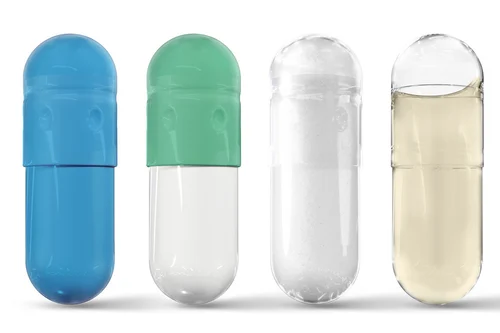
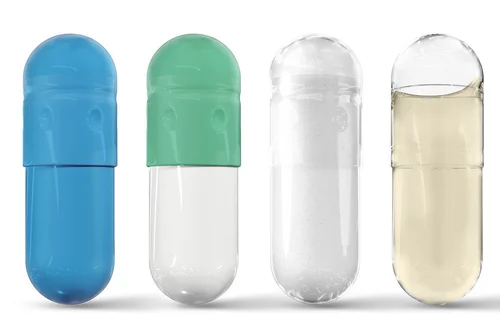
To overcome the challenges presented by the GIT, capsule technologies must be designed to withstand multiple harsh environments while preserving API integrity from manufacturing and storage through to delivery in the gut. Capsugel® Enprotect® capsules have been engineered to do just that. Manufactured using a patented bi-layered system, they provide enhanced protection without the need for additional coating, creating a robust solution for consistent, targeted drug delivery.4,5
The challenges of distal gastro-intestinal delivery
Oral formulations are used for both local and systemic treatments. To reach the whole body in systemic treatments, APIs must cross the intestinal mucosal barrier to enter the highly vascularized systemic circulation.6
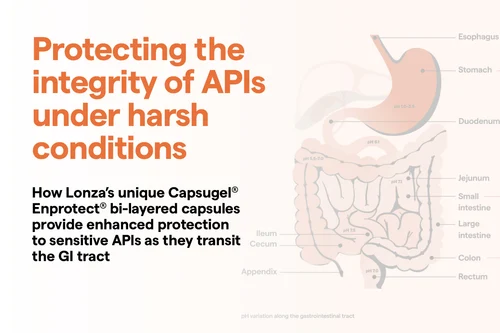
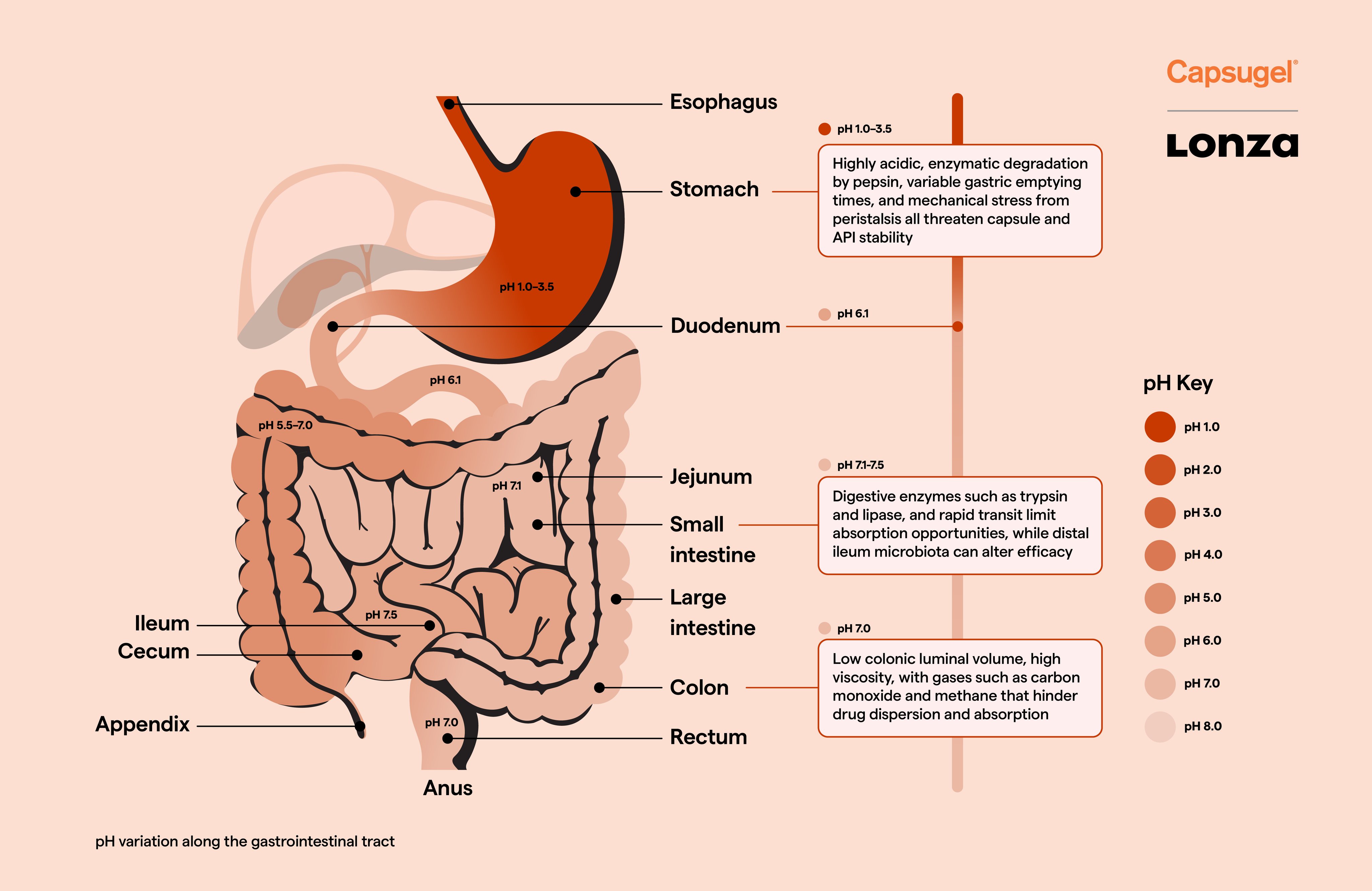
Each section of the GIT presents distinct challenges:
- Stomach: highly acidic (pH 1–3.5), enzymatic degradation by pepsin, variable gastric emptying times, and mechanical stress from peristalsis all threaten capsule and API stability1–3
- Small intestine: pH variation (6–7.5), digestive enzymes such as trypsin and lipase, and rapid transit limit absorption opportunities, while distal ileum microbiota can alter efficacy1,3
- Large intestine: pH variation (5.5–7), low colonic luminal volume, high viscosity, with gases such as carbon monoxide and methane that hinder drug dispersion and absorption1,3
As therapies become more sophisticated, demand is growing for capsule technologies capable of traversing the conditions of the GIT and delivering payloads reliably and precisely to the distal small intestine and colon.4,5
Manufacturing processes: minimizing risks to sensitive APIs
For many years, enteric protection has relied on capsules that have been coated with acid-resistant polymer layers after filling.7 These processes typically require the use of organic solvents, followed by drying. Both steps can adversely affect sensitive APIs by causing denaturation, degradation, or unwanted interactions with excipients.4,5
Capsugel® Enprotect® capsules are produced using a patented bi-layered thermo-gelation process, removing the need for solvents or heat treatment after filling. This design eliminates exposure of APIs to damaging drying conditions, while still delivering capsules with the dimensions and mechanical strength required for high-speed filling operations.4,5,8 In practice, this means pharmaceutical manufacturers can achieve robust enteric protection without compromising efficiency, scalability, or product performance.
Accelerated stability and excipient compatibility
Capsules face not only the physiological challenges of the GIT but also the risk of deterioration during storage. For manufacturers, stability is critical in both maintaining productivity and preserving therapeutic efficacy for patients.
Capsugel® Enprotect® capsules have demonstrated stability under accelerated storage conditions (40°C and 75% relative humidity for six months with 10 solid-phase excipients).9 Under these conditions, the capsules retained their enteric protection, demonstrating:9
- No capsule opening after two hours in hydrochloric acid (0.1N, pH 1.2 per Ph. Eur. specification)
- Reliable opening in phosphate buffer (pH 6.8) in less than 30 minutes
- Protection of acid-sensitive model drug, with >96% release of esomeprazole magnesium trihydrate after 30 minutes in phosphate buffer
The inner hydroxypropyl methylcellulose (HPMC) layer, with its low moisture content, further reduces the risk of API degradation or interaction.10 The mechanical properties of filled capsules were equivalent to those of empty capsules under the same conditions, underlining compatibility across a broad range of excipients.9
Capsugel® Enprotect® capsules are preservative-free, allergen-free, starch-free, and gluten-free, supporting broad use in pharmaceutical formulations. The chemically inert nature of HPMC, in part driven by being a non-ionic cellulose ether, allows for excellent compatibility with most APIs/excipients and reduces the likelihood of unwanted interactions.11,12
Compared with gelatin, HPMC has no risk of cross-linking, an inherently lower moisture content, and reduced moisture sorption ability.10,13 This means it can maintain its solubility and more effectively protect hygroscopic content from external moisture absorption.10,13
The patented Coni-Snap® closure mechanism also allows for high-speed filling and secure locking without the need for banding or sealing.
Acid resistance and structural integrity
To protect APIs through the gastric environment, capsules must resist highly acidic conditions and prevent premature release. Capsugel® Enprotect® capsules achieve this through a dual-layer design:
- An external HPMC acetate succinate (HPMC-AS) layer provides acid resistance at pH <6.0
- An inner HPMC layer maintains capsule structure and stability
Testing confirms that capsules remain intact in hydrochloric acid (pH 1.2) for more than two hours, only releasing their contents at the higher pH values found in the distal small intestine and colon.9
Protection and performance across the lifecycle
Developing oral formulations that can safely deliver advanced APIs to targeted release sites remains a central challenge in pharmaceutical science. The GIT is designed to protect humans from potentially harmful substances, but these same defense mechanisms can undermine the delivery of therapeutic APIs.
Capsugel® Enprotect® capsules overcome these challenges by combining:
- A bi-layered manufacturing process with no post-filling coating required, avoiding heat and solvent damage to sensitive APIs4,5
- Acid resistance and enzymatic stability, ensuring intact gastric transit4,5
- Compatibility with diverse APIs and excipients, enabled by HPMC’s inert profile4,5,10,11
- Proven stability in storage, maintaining capsule integrity for reliable API release9,14
- High-speed machinability, facilitating seamless integration into commercial production lines8
Capsugel® Enprotect® capsules are designed for scalability. They create a customizable platform to support the development of targeted release profiles in the distal small intestine, helping pharmaceutical companies bring new therapies to patients more efficiently and reliably.
Conclusion
Oral drug delivery remains the cornerstone of modern medicine, but it presents persistent challenges for formulators. Coatings have long been used to overcome the conditions in the GIT, maintaining capsule integrity, to allow for targeted API delivery, but the coating process itself can pose a risk to sensitive APIs.
Capsugel® Enprotect® capsules represent a breakthrough. Their patented bi-layered polymer design delivers consistent enteric protection, without the need for post-filling coating. They provide stability across the life of the capsule, from manufacturing and storage to gastric transit and targeted release, making them a powerful tool for advancing therapies that rely on oral delivery.
For pharmaceutical partners navigating the complexities of formulation and commercialization, Capsugel® Enprotect® capsules offer a solution: scientifically robust, manufacturing-ready, and aligned with the ultimate goal of delivering quality medicines to patients.
KEY TAKEAWAYS
Capsugel® Enprotect® capsules:
- Overcome key challenges of drug delivery by targeting specific distal intestinal sites4,5
- Eliminate the need for coating post-filling through bi-layered manufacturing4
- Minimize the risk to, and afford protection of, acid-sensitive APIs through robust structural integrity4,5
- Provide stability under a wide range of storage conditions, to maintaining performance9,14
To learn more about Capsugel® Enprotect® capsules and how they can protect your formulations from development to delivery, visit Capsugel® Enprotect® Capsule
References:
1. Martínez E, et al. Oral dosage forms for drug delivery to the colon: an existing gap between research and commercial applications. J Mater Sci Mater Med. 2025;36(1):24.
2. Amidon S, et al. Colon-targeted oral drug delivery systems: design trends and approaches. AAPS PharmSciTech. 2015;16(4):731–741.
3. Zheng B, et al. Design strategies, advances and future perspectives of colon-targeted delivery systems for the treatment of inflammatory bowel disease. Asian J Pharm Sci. 2024;19(4):100943.
4. Rump A, et al. In vivo evaluation of a gastro-resistant HPMC-based “next generation enteric” capsule. Pharmaceutics. 2022;14(10):1999.
5. Grimm M, et al. In vivo evaluation of a gastro-resistant Enprotect® capsule under postprandial conditions. Pharmaceutics. 2023;15(11):2576.
6. Zhang H, et al. Oral mucosal drug delivery: clinical pharmacokinetics and therapeutic applications. Clin Pharmacokinet. 2002;41(9):661–680.
7. Salawi A. Pharmaceutical Coating and Its Different Approaches, a Review. Polymers. 2022;14:3318.
8. Technical reference file. Lonza Capsules and Health Ingredients. 2023.
9. Dumont C, et al. Evaluation of the compatibility of Capsugel® Enprotect® capsules with solid phase excipients to accelerate developments of new enteric drug products. Poster presented at the meeting of the American Association of Pharmaceutical Scientists, 22–25 Oct 2023, Orlando. Poster: T1330-01-05.
10. Biyani M. HPMC capsules for moisture sensitive and hygroscopic products. Pharm Sci Tech. 2021;5(2):50–52.
11. Vlad R, et al. Hydroxypropyl Methylcellulose—A Key Excipient in Pharmaceutical Drug Delivery Systems. Pharmaceutics. 2025;17(6):784.
12. Sahoo CK, et al. HPMC a biomedical polymer in pharmaceutical dosage forms. J Chem Pharm Sci. 2015;8(4):875–881.
13. Yang N, et al. Moisture sorption and desorption properties of gelatin, HPMC and pullulan hard capsules. Int J Biol Macromol. 2020;159:659–666.
14. Jannin V, et al. Enteric properties of Capsugel® Enprotect® capsules filled with fecal microbiota transplant are confirmed after 12-month storage at -80°C. Poster presented at the meeting of the European Conference on Pharmaceutics, 24–25 March 2025, Porto.